Republic of Indonesia · Visa concierge
Kitas VIP
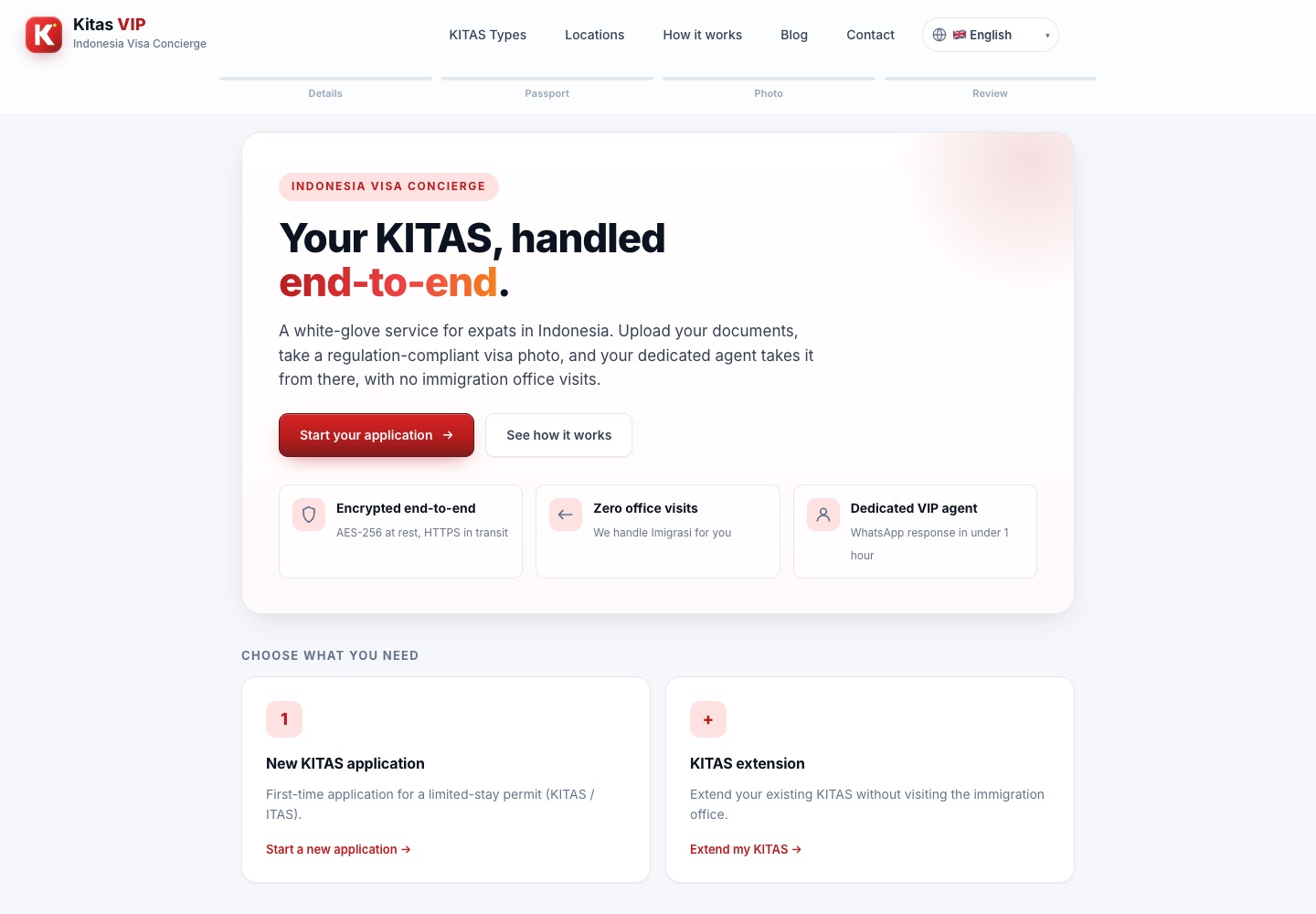
Apply for an Indonesian stay permit from a phone, with no immigration office visits. We built the applicant flow, the document capture, the security model and the agent workflow behind it.
Paspor · Passport
KITAS VIP
INDONESIA VISA CONCIERGE
Data page
- Service
- KITAS applications and extensions
- Permit types
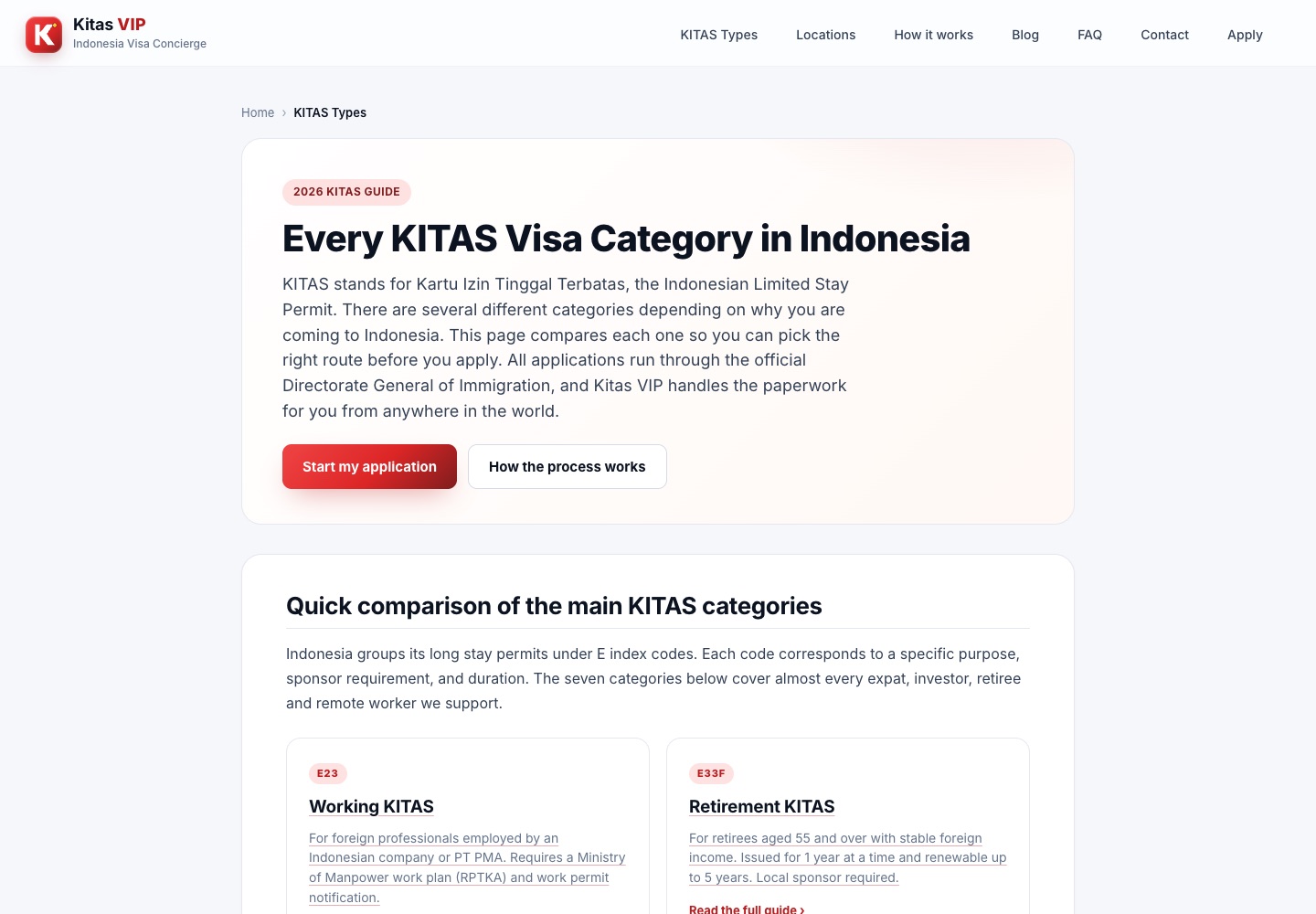
- 7, each with its own page
- Locations
- Bali, Jakarta, Canggu, Ubud
- Languages
- 12, with Indonesian pages of their own
- Backend
- Express on Vercel, Turso database
- Workflow
- Open Doors, no separate admin panel
- Contact form
- Nine separate spam checks
Visa pages
Six stamps between submit and an agent picking it up
Every step after the first two is fail-soft. If the photo processor or the CRM is slow, the application still goes through and nobody is turned away.
Required fields checked, inputs trimmed, and no more than five submissions a minute from one address.
A KITAS reference number is issued and the database transaction opens.
Applicant details and every document are sealed with AES-256-GCM, each blob with its own initialisation vector.
The contact is upserted in Open Doors and an opportunity opens in the VISA Process pipeline, carrying the visa fields and the service fee as its value.
Passport, previous visa and photo are uploaded to the contact with an internal note, so the agent sees the file, not an attachment hunt.
A branded confirmation email goes out with a button straight to the status page, already filled in.
The decision we are proudest of
A generative model for the photo. Never for the passport.
Generative models can quietly rewrite text. On a selfie that does no harm. On a passport whose machine-readable line decides someone’s immigration status, one changed character is a disaster. So the two documents go through different machinery.
The photo
The applicant’s selfie is processed by an image model that replaces the background with the flat regulation red, relights the edges and keeps head and shoulders framed. If it fails, the original is kept and the application carries on.
The passport
Scanned on the phone itself with computer vision that only moves and selects pixels. It cannot invent a letter.
- 1Align. Feature points on each of the four guided captures are matched to the first frame, and the frames are warped so the letters overlap.
- 2Remove glare. For every pixel across the aligned frames, the brightest value is dropped and the rest averaged. The highlight caught at one angle disappears.
- 3Flatten. The largest four-sided outline is found and the page is corrected to a straight rectangle.
- 4Sharpen. Adaptive contrast on the lightness channel keeps faded passport print readable.
Security page
Built like it holds passports, because it does
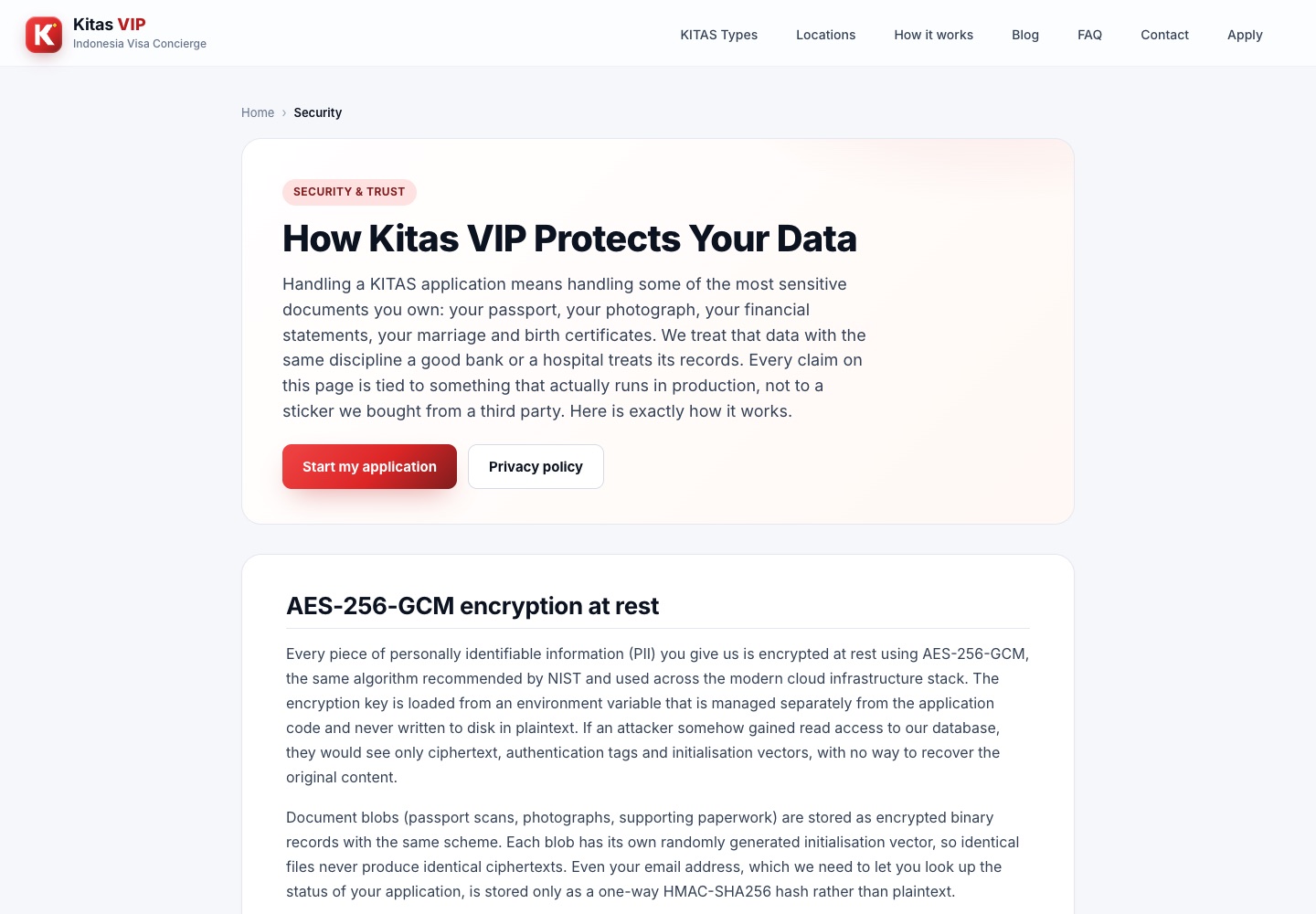
- AES-256-GCM at rest for every applicant field and document, with the key kept apart from the code.
- Email stored as a one-way hash, so the status lookup works without keeping the address in plain text.
- Rate limits on submissions and on status lookups.
- Open Doors as the record. Status, notes, approvals and document review all happen there. The database keeps an encrypted backup and nothing more.
The site’s own security page explains each of these in plain language, tied to what actually runs in production.
Status page
Where is my KITAS?
Reference and email bring back the live stage from the Open Doors pipeline, drawn as a stepper with the current stage lit.
Permit types
Locations
Plus guides on documents, timelines, KITAS against KITAP, renewals and self-applying.
Handling documents people cannot afford to lose?
Visa, legal, finance, health. We build application flows that are easy on a phone and strict about the data.